


You’ve probably heard the word “amortization” tossed around while shopping for a mortgage, and if it left you scratching your head, don’t worry. Our team at Mortgage Connection knows it sounds technical, but it plays a huge role in how much you pay over the life of your mortgage and how long it takes to pay off your loan.
Amortization is the process of paying off a loan through regular, scheduled payments over a set period of time, with each payment chipping away at both the amount you borrowed and the interest you owe. Once you understand how it works, you can plan your money with a lot more clarity.
What Amortization Means
At its core, amortization describes how a value or a debt shrinks over time. Every time you make a payment towards your mortgage, it gets you closer to owning your property outright. Amortization can help give you a clear picture of what you still owe at any point, so you’re never guessing about your balance.
How Amortization Works on a Mortgage
When you take out a mortgage, you don’t pay it all back at once. Instead, you make regular payments, often monthly or bi-weekly, that slowly reduce your debt over time.
Each payment does 2 important jobs. Part of it goes toward the principal, which is the amount you originally borrowed. The other part covers the interest, which is what the lender charges you to borrow that money.
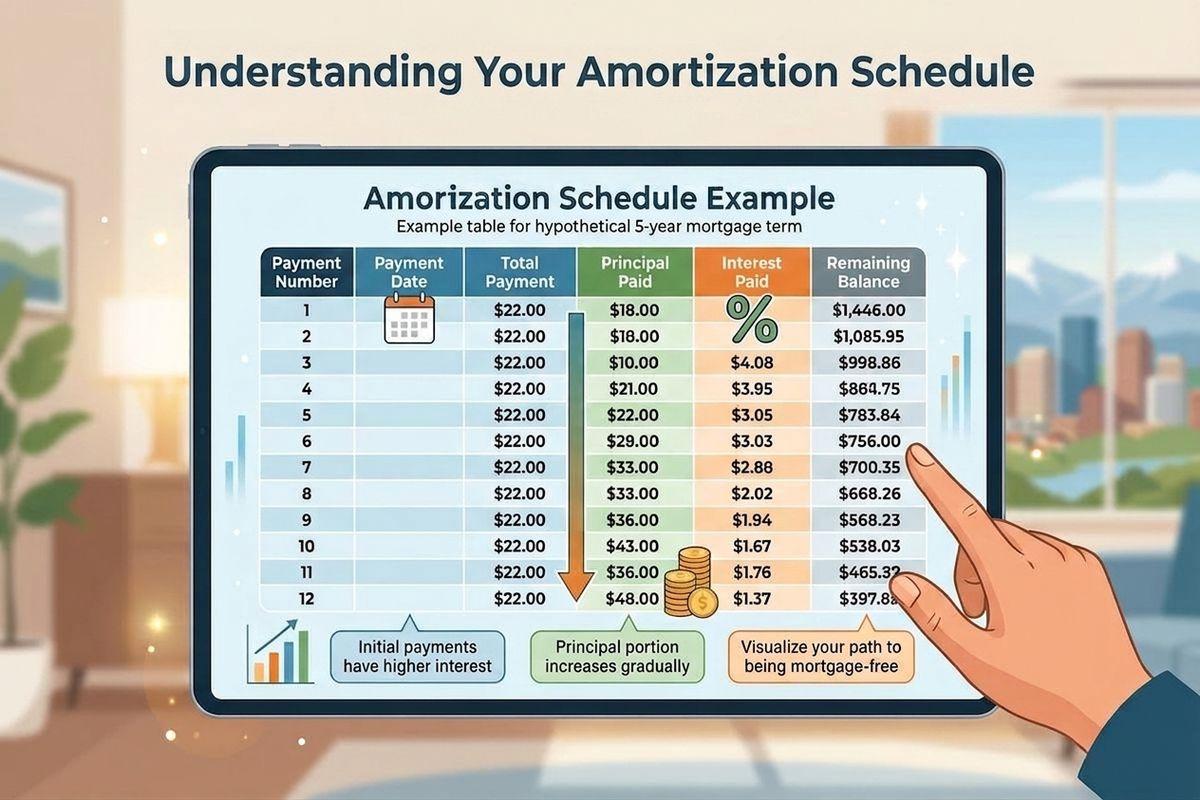
Here’s something that surprises a lot of homeowners. Early in your mortgage, a larger portion of each payment typically goes toward interest. As your balance decreases, more of your payment generally goes toward principal.
Term vs. Amortization Period
You might see a mortgage described as a “5-year term with a 20-year amortization.” These 2 numbers mean very different things, so it’s important to understand how each of them works.
The “term” is the length of your current contract with the lender. When it ends, you renew or renegotiate your mortgage. The amortization period, however, is the estimated length of time it would take to pay off the mortgage in full based on your payment schedule.
So in that example, you’d finish your 5-year contract, then renew again until the full 20 years are up and the loan is fully paid off.
What an Amortization Schedule Shows You
An amortization schedule can act sort of like a roadmap for your loan. It lays out every payment from start to finish, so you can see where your money goes. This schedule can show a few key details:
- The original loan amount and the interest rate
- The balance remaining after each payment you make
- How each payment is split between principal and interest
Amortization vs. Depreciation Explained
People often mix up amortization and depreciation, but they cover different things. Amortization applies to loans and intangible items, meaning things you can’t physically touch.
Depreciation, on the other hand, applies to material objects that lose value over time, like a vehicle or piece of machinery.
In simple terms, your mortgage debt amortizes as you pay it down over the years. The car sitting in your driveway depreciates as it ages and racks up kilometres. One tracks a shrinking loan, the other tracks a shrinking value.
Why Amortization Matters for Your Finances
Understanding amortization can help you better understand, and therefore make more informed decisions about your money. When you know how your payments break down, you can budget ahead and plan for the years to come with fewer surprises.
It also helps you see how your choices affect the total interest you pay. A longer amortization means smaller monthly payments, but you’ll pay more interest over time. A shorter amortization period costs more each month, but it saves you money in the long run.
Discuss Your Options with a Mortgage Broker
These trade-offs can feel tricky to weigh on your own. That’s where the mortgage brokers in Calgary and Edmonton at Mortgage Connection can help. Our team can walk you through your amortization period and show you how each path affects your bottom line. Reach out today and get the clarity you deserve.